Reporting and Clinical Decision Support | Moana Digital Health
Moana consolidates data from every module into real-time dashboards, automated clinical alerts, programme-level reports, and Ministry-ready national health outputs built on FHIR R4 structured data.
" height="11.607177083333333px" id="F3jyorGue" transform="translate(1.339 8.927)" width="22.321395833333213px"/><path d="M 0.874 3.575 L 10.021 9.486 C 10.367 9.71 10.764 9.821 11.161 9.821 C 11.558 9.821 11.954 9.71 12.301 9.486 L 21.447 3.575 C 21.995 3.221 22.321 2.63 22.321 1.991 C 22.321 0.893 21.4 0 20.267 0 L 2.054 0 C 0.921 0 0 0.893 0 1.992 C 0 2.63 0.327 3.221 0.874 3.575 Z" fill="rgb(27, 18, 61)" height="9.821395833333332px" id="KOAXH2cGk" transform="translate(1.339 4.464)" width="22.321395833333213px"/></svg>)
contact@moanadigitalhealth.com
Overview
Health systems generate substantial data. The problem is rarely a shortage of data. The problem is that the data is fragmented across departments, stored in formats that do not connect to each other, and requires manual extraction and collation before it can inform any decision above the individual clinical encounter level. A facility manager who wants to know the bed occupancy rate for the past week manually counts bed allocation logs. A programme officer who needs ANC coverage rates for the quarterly donor report manually tallies ANC registers. A national programme director who needs immunisation coverage rates by district manually compiles facility-level returns.
The Reporting and Clinical Decision Support module eliminates this manual extraction layer entirely. Every piece of data captured in Moana is structured, attributed, and available for analysis at the moment it is entered, without any additional step. The same data that drives a clinician's bedside decision about a patient's drug interaction risk is the same data that drives a facility manager's operational dashboard, a programme officer's coverage report, and a Ministry's national health indicator output. There is one data layer, and it serves every reporting level simultaneously.
Clinical decision support operates within the same framework. Automated rules run continuously across the clinical data layer, checking for conditions that require clinical action: an overdue review, a dangerous drug interaction, a dosing error, a missed preventive care intervention. These rules are configurable, overridable, and audited. They support clinical judgement without replacing it.
For national-level reporting, the module connects directly to DHIS2 for aggregate indicator submission, supports FHIR bulk data export for national health information exchange platforms, and generates standard report outputs in the formats required by WHO, development partners, and national audit frameworks.
Core Capabilities
Real-Time Operational Dashboards
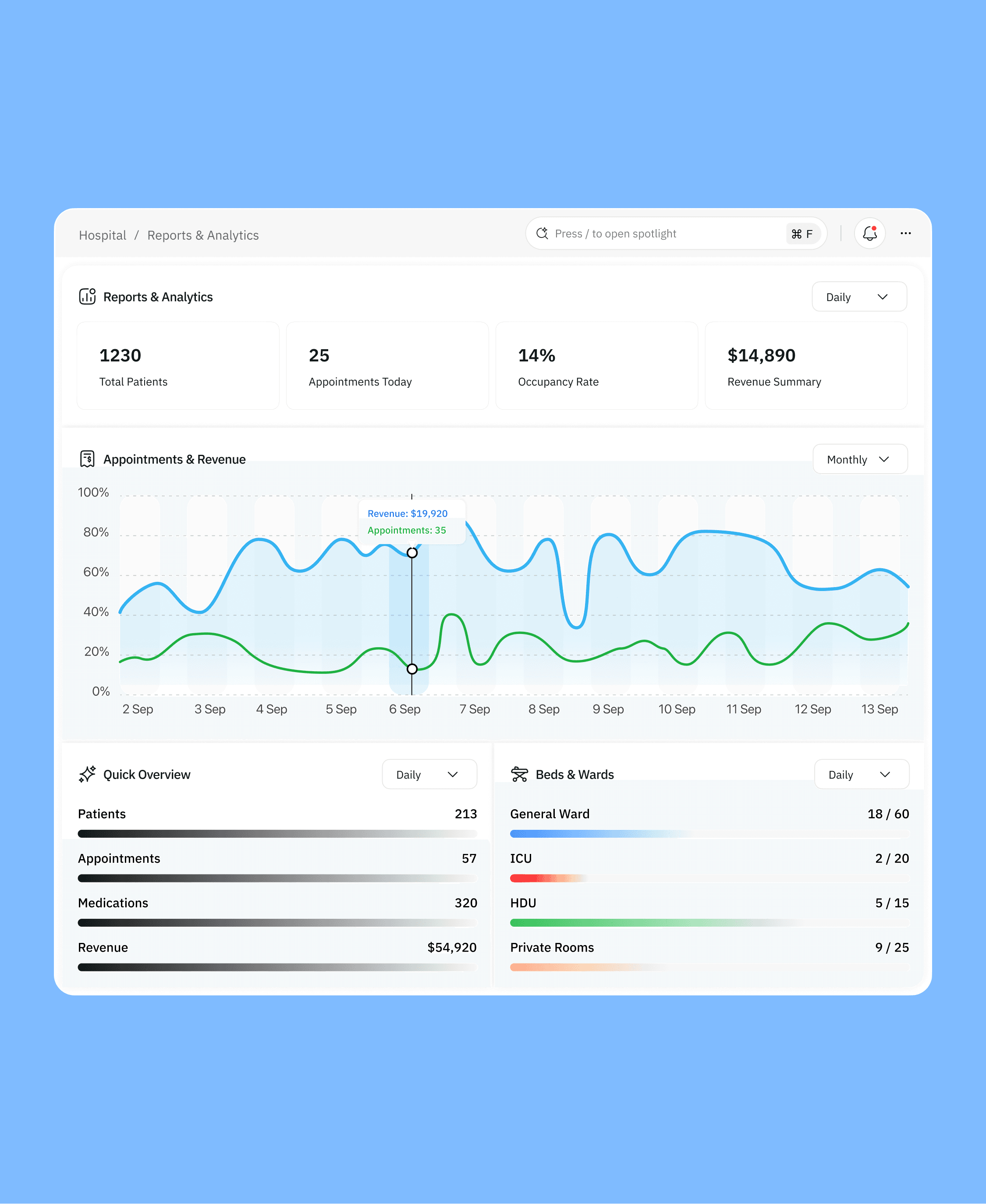
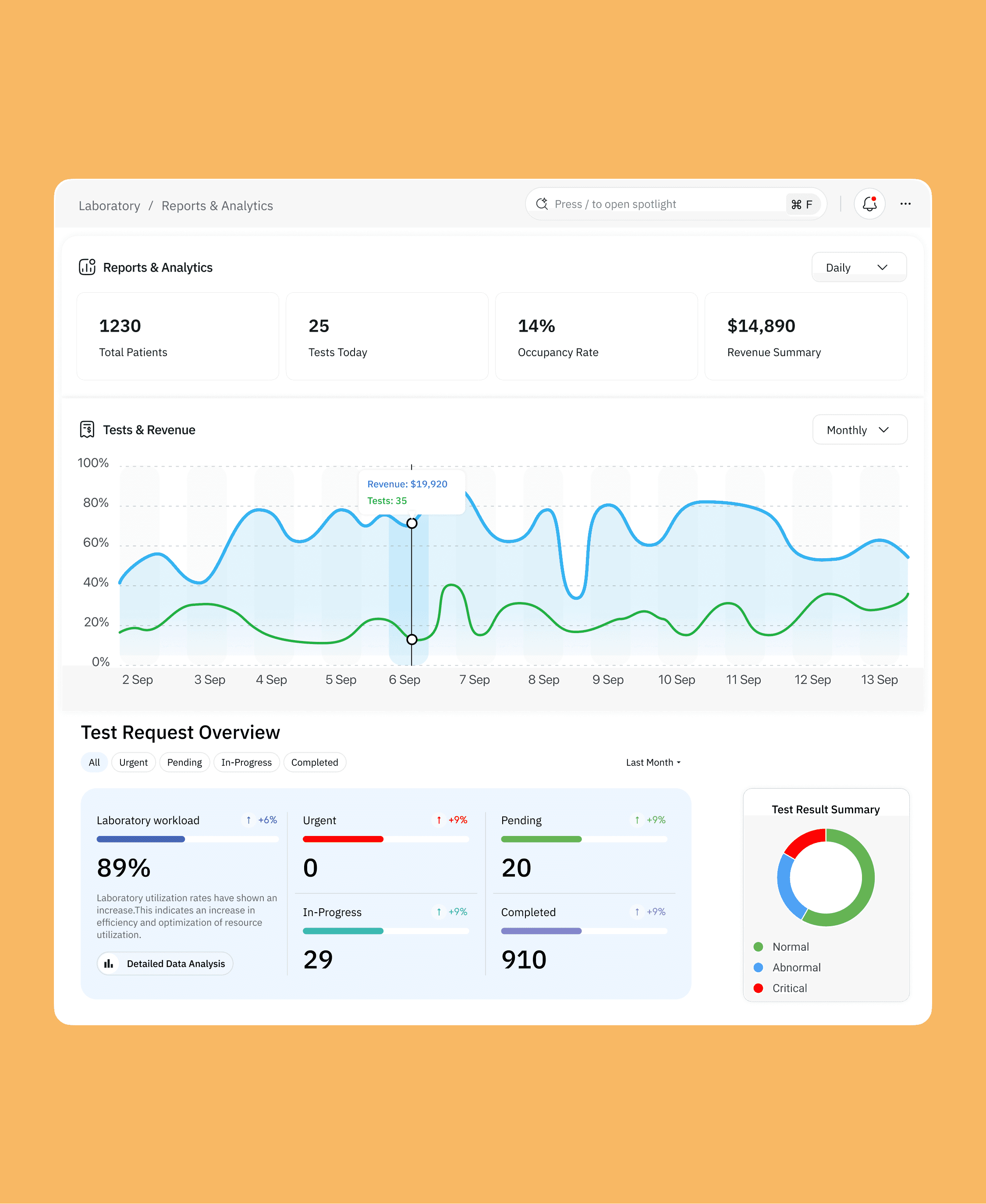
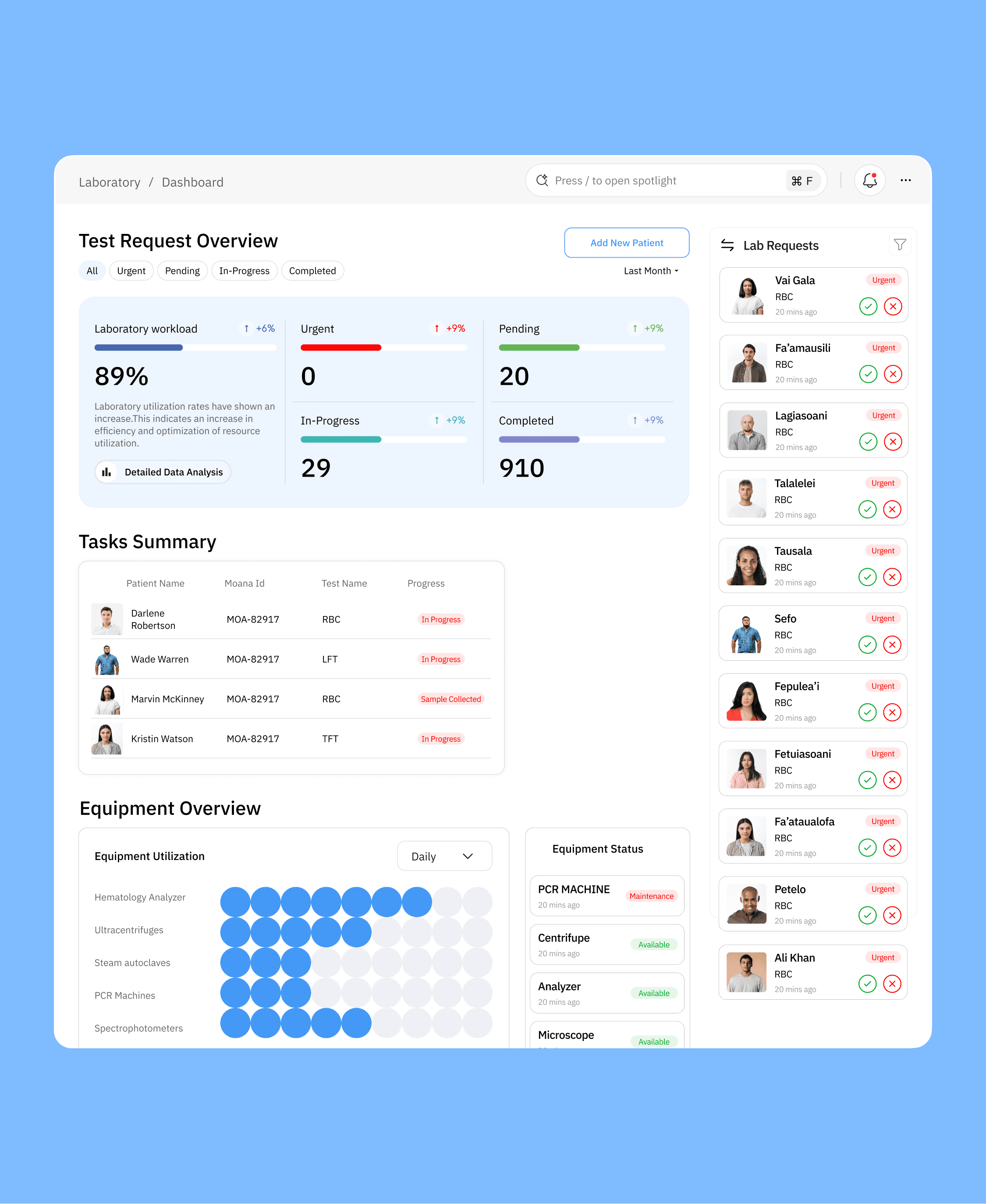
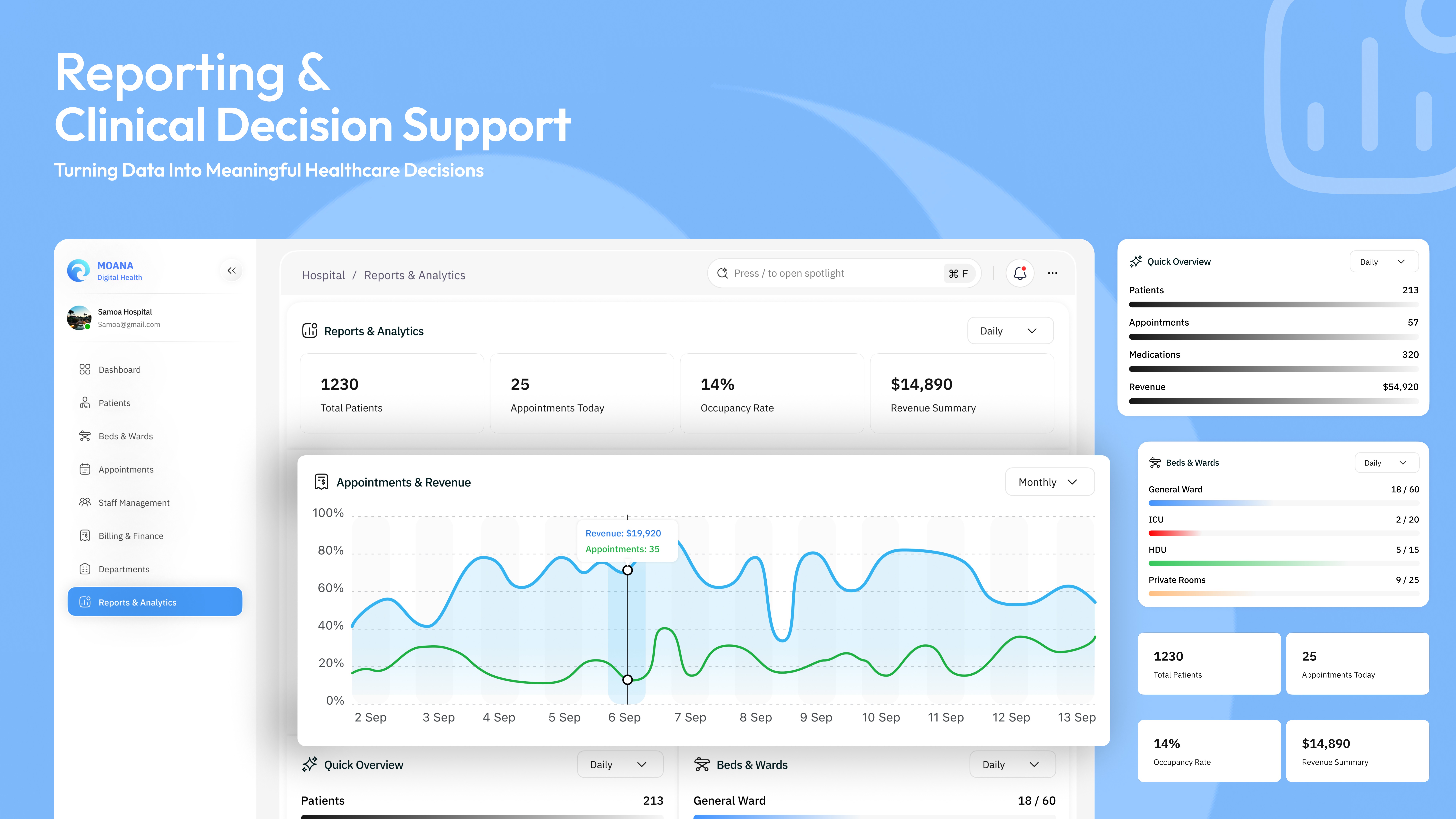
Interactive dashboards provide live operational visibility at every level of the health system. Facility-level dashboards show daily patient census, current bed occupancy by ward, admissions and discharges in the past 24 hours, laboratory turnaround times by test type, emergency wait times by triage category, pharmacy stock status for essential medicines, and outstanding clinical tasks. Department-level dashboards show ward-specific metrics relevant to charge nurses and department heads. Network-level dashboards show aggregate performance across all connected facilities. All dashboards update via WebSocket in real time, reflecting the current state of the facility without page refresh or scheduled report runs.
Custom Report Builder
Administrative and programme staff build custom reports from any data in the platform without requiring technical support or developer involvement. Report parameters span every data domain: patient demographics, diagnoses by ICD-10 code, treatment outcomes, medication usage patterns, laboratory result distributions, diagnostic imaging volumes, immunisation coverage by antigen, ANC visit attendance, growth monitoring outcomes, service utilisation by department, and financial performance by revenue category. Built reports can be saved as templates, scheduled for automatic generation on daily, weekly, monthly, or custom cadence, and configured for automatic distribution to defined recipients.
Clinical Decision Support Alerts
Four categories of clinical decision support rules operate continuously across the clinical care layer. Alert rules fire at defined clinical thresholds: a prescription for a medication the patient is allergic to, a laboratory result in the critical value range, a patient with type 2 diabetes who has not had an HbA1c measurement in the past 90 days, a child on the vaccination schedule who is overdue for a dose. Recommendation rules surface advisory guidance based on patient data without requiring immediate action. Workflow step rules insert mandatory confirmation or second-clinician sign-off steps into specific clinical processes. Preventive care rules manage population-health interventions across the patient panel, including cervical screening recalls, diabetic eye review reminders, and antenatal visit attendance alerts.
All clinical decision support rules are configurable per facility without developer involvement. Every alert can be suppressed for a defined period if the clinician confirms it is not relevant for a specific patient. Every override requires a documented reason and is retained in the audit trail, supporting governance review of clinical decision support compliance rates and override patterns.
Programme-Level Reporting and Cohort Analytics
Programme-level reports aggregate outcomes across disease management and vertical programme cohorts. TB treatment completion rates, HIV viral suppression rates, ART cohort retention at 12 months, PMTCT mother-to-child transmission rates, NCD screening coverage, and ANC4+ attendance rates are all computable from the structured clinical data in the platform without manual calculation. Defaulter identification lists patients enrolled in a programme who have missed a scheduled visit or medication collection, enabling targeted follow-up by programme staff. Trend analysis shows whether programme performance is improving, stable, or declining over time.
National Health Reporting and DHIS2 Integration
The platform generates standardised outputs for national health information systems. A bidirectional DHIS2 Web API connector pushes aggregate indicator data as DHIS2 Data Value Sets on configurable schedules, pulling organisation unit hierarchy from DHIS2 to ensure facility alignment. Ministry of Health users can export facility data, district aggregates, and national totals in the formats required for quarterly and annual national health reports, WHO country reporting, development partner M&E frameworks, and SDG progress reviews. Report generation is automated: standard report packs run on scheduled cadence without manual intervention.
FHIR Bulk Export
The FHIR R4 Bulk Data Access specification is supported for population-level data extraction by authorised systems. Bulk export enables national health information exchange platforms and research institutions to access de-identified or pseudonymised aggregate data for population health analysis, epidemiological research, and health system performance benchmarking, subject to Ministry-level authorisation and governance controls. All bulk export events are logged in the audit trail with the requesting user, timestamp, data scope, and export format.
Bed Occupancy and Operational KPI Reporting
Standard operational KPI reports cover the metrics most critical for health system management: average length of stay by ward, diagnosis group, and clinician; bed turnover rate by ward; facility-wide and ward-level occupancy rates over time; emergency wait time compliance by triage category; laboratory turnaround time compliance by test type; appointment no-show rates by clinic type; and pharmacy stock coverage days for essential medicines. These KPIs are available as real-time dashboard elements and as scheduled management reports, providing both operational awareness and management accountability data.
Flexible Data Export
All report outputs are available in Microsoft Excel, CSV, and PDF formats. Reports generated programmatically for scheduled distribution are stored in the platform's document management layer with version history. FHIR bulk export supports structured JSON data exchange for technical integration with external analytics platforms, population health management tools, and national digital health infrastructure.
Who Uses This Module
Facility Managers and Department Heads
Access real-time operational dashboards for their facility and departments. Generate and review KPI reports. Configure clinical decision support rules.
Programme Officers and NCD Coordinators
Run programme cohort reports, identify defaulters, track treatment outcomes, and generate M&E report outputs for programme reporting.
Ministry of Health and National Programme Directors
Access network-wide aggregate reporting, national indicator outputs, and DHIS2-compatible data exports without accessing individual clinical records.
Clinical Governance and Quality Teams
Review clinical decision support override audit logs, compliance rates, and quality indicator trends for governance and accreditation purposes.
How This Connects to the Rest of Moana
The Reporting module draws structured data from every other module in the platform, including Patient Management, Clinical Care Management, Laboratory, Pharmacy, Radiology, MCH, Billing, Surveillance, and Medical Supply. Clinical decision support rules operate within the Clinical Care Management and Pharmacy modules and are configured and monitored from Reporting. National reporting outputs connect to the DHIS2 connector and the moana-surveillance layer for population-level indicator aggregation.
Standards and Interoperability
All reportable data is captured to FHIR R4 standards throughout the platform, making the reporting layer a structured query layer on FHIR-formatted data rather than a proprietary data extraction exercise. FHIR R4 Bulk Data Access specification support enables standards-compliant population-level data exchange. DHIS2 Web API integration supports bidirectional aggregate data exchange with national health information systems. Report outputs are formatted to WHO indicator definitions and SDG reporting frameworks.